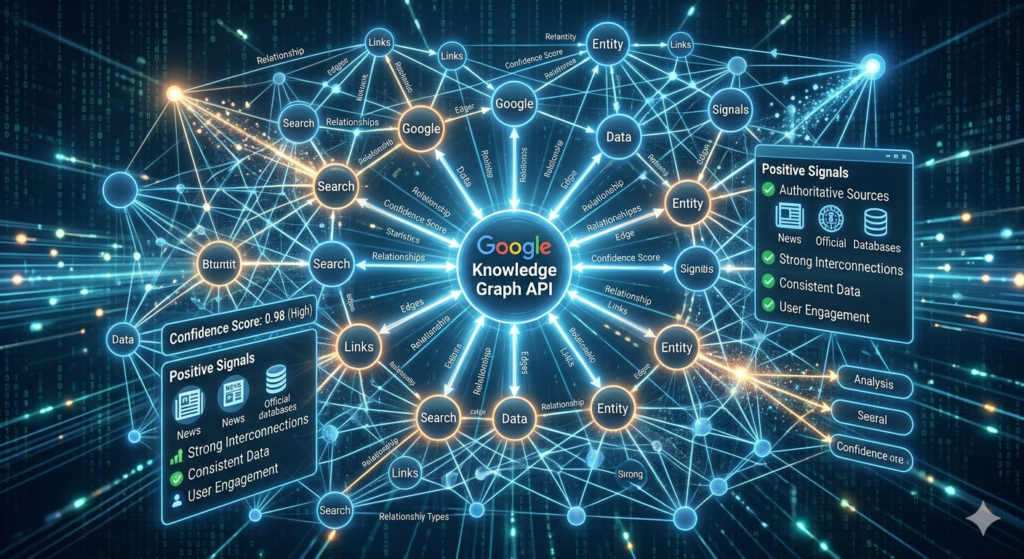
I first stumbled across the idea of a confidence score while playing around with the Google Knowledge Graph Search API — which, admittedly, is a very SEO way to spend your free time.
The field Google officially returns is called resultScore. It does not literally say: “Congratulations, Google trusts you 87%.” But it does show how strongly Google connects a search query with a specific entity in its Knowledge Graph.
That becomes interesting very quickly.
When I tested queries like “SEO,” “Suchmaschinenoptimierung,” and “search engine optimization,” the same main entity appeared with the same Knowledge Graph ID — but with different confidence scores. In other cases, especially with person entities, I noticed that the panel and ID can stay the same across different languages, while the description changes.
So the entity remains stable, but the confidence around language, context and query wording shifts.
That is why I think this topic matters far beyond the API itself. Google, Knowledge Panels, AI Overviews, AI Mode and LLM-based search systems all depend on one basic question:
How confidently can a machine understand who or what something is — and what it is connected to?
What the Google Knowledge Graph resultScore Actually Shows
Before we go too deep into the term confidence score, we need to be precise.
Google itself does not call this field “confidence score” in the Knowledge Graph Search API. The official field is called resultScore, and according to Google, it indicates how well an entity matches the request constraints.
That sounds dry. Very Google. Very “this is not a ranking factor, please stop writing blog posts about it.”
But for anyone working with SEO, entity optimization or Knowledge Panels, the field is still extremely interesting. Because even if Google does not officially call it a confidence score, it behaves like a visible clue into something we rarely get to see: how strongly Google connects a query with a specific entity.
For example, when I searched for SEO, Suchmaschinenoptimierung and search engine optimization, the same main entity appeared with the same Knowledge Graph ID. So Google understood that these queries point to the same concept. But the scores were different.
That matters.
It suggests that Google can understand that different words, languages and spellings refer to the same entity — but not necessarily with the exact same strength. The entity may be the same, but the confidence of the match can change depending on the query.
This is also where Kalicube’s Knowledge Graph API Explorer becomes useful. In its interface, Kalicube labels this value as “confidence” and fills that column with the API’s resultScore. Strictly speaking, that is an SEO interpretation of Google’s field, not Google’s own naming. But it is a helpful interpretation, because it makes the concept easier to understand: the higher the score, the more confident the system appears to be that this is the entity you are looking for.
That does not mean a higher score automatically gives you a Knowledge Panel. It also does not mean this is a direct SEO ranking factor. But it does show something important:
Google does not just store entities. It compares them, ranks them, disambiguates them and connects them to queries.
And that is where the topic becomes bigger than a single API field. Because if a machine has to decide between several possible meanings, it needs signals. If someone searches “Amazon,” does that mean Amazon.com, Amazon Prime Video, Amazon Fresh, AWS, the Amazon rainforest, the Amazons from Greek mythology or something else entirely?
The resultScore gives us a small glimpse into that process.
It shows that entity understanding is not binary. Google does not simply think: “I know this” or “I do not know this.” Instead, there seems to be a spectrum of confidence, relevance and contextual fit.
And for brands, people and organizations, that is the whole game.
You do not just want Google to know that you exist. You want Google to understand you clearly enough to connect you with the right name, the right description, the right topics, the right services, the right people and the right sources.
Why the Same Entity Can Have Different Confidence Scores
One of the most interesting things I noticed while testing the Knowledge Graph Search API was this: the same entity can appear with the same Knowledge Graph ID, but with different confidence scores depending on the query.
That sounds small, but it is actually a very important point.
If I search for “SEO,” “Suchmaschinenoptimierung,” and “search engine optimization,” Google may understand that all three queries refer to the same general concept. The entity can stay the same. The ID can stay the same. But the score can still change.
In other words: Google can recognize the entity, but the strength of the match is not always identical.
That makes sense. A short abbreviation like “SEO” may be more commonly used, but also more ambiguous. A German term like “Suchmaschinenoptimierung” may be clearer in a German-language context. The full English term “search engine optimization” may be more descriptive, but still connected to a different linguistic and regional environment.
Same entity. Different query. Different confidence.
This becomes even more interesting when looking at person entities. In some cases, different language queries can lead to the same panel and the same Knowledge Graph ID, while the description changes depending on the language or source context.
That means Google may keep the underlying entity stable, but adapt the way it describes that entity.
For anyone working on personal branding, Personal Knowlege Graphs, Knowledge Panels or multilingual SEO, this is a very important lesson. Your entity is not just one fixed label. It is a multilingual, multi-contextual object that can be recognized through different names, translations, descriptions and relationships.
And that also means you need to think beyond one perfect keyword.
If a company only describes itself in English, but wants to be understood in German, Spanish, French or Italian search contexts, there may be a gap. If a person is described as a journalist on one platform, an SEO specialist on another and a filmmaker somewhere else, Google may still understand that it is the same person — but the confidence around each role can vary.
This is not necessarily bad. Real people and real brands are allowed to have more than one dimension. Annoying, I know. Very inconvenient for databases.
But the machine still needs order.
The goal is not to make every profile, language version and source say the exact same robotic sentence. The goal is to make sure the core facts stay consistent:
- Who is the entity?
- What is the official website?
- What are the main names or aliases?
- What does the entity do?
- Which topics, services, people, organizations and projects belong to it?
When those signals are clear, different queries can still point back to the same entity. And that is exactly what we want.
Why Confidence Scores Matter for Knowledge Panels
Once you do have an entry in the Knowledge Graph Search API, you technically do have a knowledge panel. It might lot very fancy, no images, no texts, just the name or brand, but you do have a Knowlege Panel.
But a Knowledge Panel is not just a fancy search result box. It is Google saying: “We believe this thing is a real, recognizable entity, and we have enough information to summarize it.”
That is why confidence matters.
Google does not only need to find your website. It needs to understand that you are a specific person, brand, organization, product, place, work or concept. It also needs to separate you from similar names, related topics and possible misunderstandings.
This is where entity confidence becomes important. If Google sees a name once, that is a signal. If it sees the same name connected to a website, social profiles, articles, structured data, interviews, databases, company pages and consistent descriptions, that signal becomes stronger.
A Knowledge Panel is not created because one page says, “Trust me bro, I am important.”
It appears when enough reliable signals across the web point in the same direction.
The Confidence Score Is Not the Panel — But It Can Reveal the Problem
This is where we need to be careful. A higher resultScore in the Knowledge Graph Search API does not automatically mean you will get a fancier Knowledge Panel (but it increases the chances). It also does not mean that Google will show your entity more often in search results.
But it can help diagnose a problem.
If your brand name returns the wrong entity, that is a problem.
If your name returns many unrelated entities before your own, that is a problem.
If your official entity appears only for one exact query but disappears for variations, translations or common abbreviations, that is also a problem.
That does not mean the API is showing you the full truth. It is only one window into Google’s entity system. But sometimes one window is enough to notice that the house is on fire.
For Knowledge Panel optimization, this can be extremely useful. You can test whether Google connects your entity to your official name, alternative names, translated names, services, projects or important topics.
The goal is not to chase a random number. The goal is to understand whether Google can clearly identify you.
Ambiguity Is the Enemy
A lot of Knowledge Panel problems are really ambiguity problems.
Maybe your name is common.
Maybe another person has the same name.
Maybe your brand name sounds like a product category.
Maybe your company has different spellings across platforms.
Maybe your website says one thing, LinkedIn says another, and old profiles say something completely different.
For humans, this is often easy to understand. We can look at context and say: “Yes, obviously this is the same person.”
Machines are not always that generous.
They need repeated, structured, consistent confirmation. They need to see that the website, social profiles, articles, databases, images, descriptions and relationships all belong to the same entity.
That is why Knowledge Panel optimization is not just about adding Schema markup. It is about reducing confusion.
You want Google to have fewer reasons to hesitate.
A Strong Entity Has Strong Relationships
One important lesson from the Knowledge Graph is that entities do not exist alone. They are connected to other entities.
A person can be connected to an employer, job title, university, articles, films, awards, locations, interviews and social profiles.
A company can be connected to founders, employees, services, products, industries, clients, case studies, events and publications.
A service can be connected to problems, methods, tools, outcomes, experts and examples.
These relationships help Google understand not only that an entity exists, but what it belongs to.
That is why a brand should not only optimize its own homepage. It should also build clear connections between all relevant parts of its entity network.
For example, an SEO agency should make it easy to understand:
Who works there?
What services does it offer?
Which topics does it specialize in?
Which clients, industries or case studies prove that?
Which authors write about those topics?
Which external sources confirm the same facts?
This is where confidence becomes practical. The more clearly your entity is connected to the right surrounding entities, the easier it becomes for machines to understand what you should be associated with.
The Real Goal: Becoming Harder to Misunderstand
The goal of Knowledge Panel optimization is not to manipulate Google into showing something fake. That would be stupid, risky and honestly kind of cringe.
The real goal is much simpler:
Make the truth easier to understand.
If you are a person, make it clear who you are, what you do and which work belongs to you.
If you are a company, make it clear what you offer, where you are based and who is behind it.
If you are a brand, make it clear which products, services, people and topics are genuinely connected to you.
A good Knowledge Panel is not just a trophy. It is a sign that Google has built enough confidence around your entity to present it directly in search.
And in an AI-driven search world, that kind of confidence becomes even more important.
Why Confidence Scores Matters Even More for LLMs and AI Search
Knowledge Panels are already important, but they are only one part of the bigger picture. The more interesting shift is happening around AI search, AI Overviews, AI Mode and large language models.
Classic search often sends users to a list of pages. AI search tries to answer, summarize, compare, recommend and explain. That means the system has to decide which entities are relevant, which facts are reliable and which sources should be used to construct an answer.
In that environment, confidence becomes even more important.
A search engine can rank ten blue links even when it is not perfectly sure what the user wants. An AI answer has to be more direct. It has to say something. It has to choose. And when machines choose, they need confidence.
AI Systems Need to Know What They Are Talking About
An LLM does not only need text. It needs context.
If a user asks for “the best SEO expert for structured data,” the system needs to understand several things at once: What is SEO? What is structured data? Which people are associated with that topic? Which sources confirm their expertise? Are there clear profiles, articles, references, case studies or external mentions?
That is an entity problem.
The same applies to brands. If someone asks for “a CRO agency in Germany,” the system has to connect an organization with a service, a location, proof of expertise and probably a commercial intent. If your website says “conversion optimization,” your schema says “digital marketing,” your case studies say “landing page testing,” and external sources say nothing at all, the system may still understand you — but maybe not confidently enough to recommend you.
That is why I think confidence is one of the most useful ways to think about AI visibility.
Not as one official score. Not as a secret number hidden inside Google. But as a practical question:
Can a machine clearly identify this entity, verify it from multiple sources and connect it to the right topics?
AI Search Rewards Clear Entity Networks
The future of SEO will not only be about publishing more content. Honestly, the internet already has enough generic content to make every crawler cry.
The bigger advantage will come from building clearer entity networks.
For a person, that means connecting their name to their website, job title, employer, articles, projects, social profiles, topics and credentials.
For a company, it means connecting the brand to its services, employees, founders, clients, case studies, industries, tools, locations and external references.
For a service page, it means showing what the service is, who provides it, what problems it solves, which methods are used and where there is proof.
This matters because LLMs and AI search systems do not just look for keywords. They try to understand relationships.
A weak website says: “We do SEO.”
A stronger website says: “This company provides SEO services.”
An even stronger entity network says: “This specific company, based in this location, with these people, these case studies, these articles, these external mentions and these structured data signals, is repeatedly associated with technical SEO, structured data, content strategy and AI search optimization.”
That is a very different level of clarity.
And that is exactly where confidence comes in. The easier it is for machines to connect the dots, the more likely they are to understand the entity correctly when it matters.
What Actually Builds Entity Confidence
If confidence is the goal, the next question is obvious: how do you build it?
Not by adding one magical Schema block and hoping Google suddenly whispers, “Finally, I understand you.” Sadly, that is not how it works.
Entity confidence is built through repetition, consistency and verification. A machine needs to see the same core facts again and again, in the right places, connected to the right surrounding entities.
That does not mean every profile on the internet has to use the exact same sentence. That would look unnatural and honestly a little creepy. But the core identity should stay stable.
A person should not look like five completely different people across five platforms.
A company should not describe itself as an SEO agency on one page, a software company on another, and a lifestyle magazine somewhere else.
A service should not be called ten different things without any clear relationship between those terms.
Machines can handle nuance. They just need structure.
A Clear Entity Home
Every important entity should have one central home.
For a person, that is usually an About page.
For a company, it might be the homepage or About page.
For a service, it is a dedicated service page.
For a product, it is a product page.
For a project, film, event or publication, it should be a specific page with enough context.
This page should make the basic facts extremely clear:
Who or what is this?
What is the official name?
Are there alternative names or translations?
What type of entity is it?
What does it do?
Which website or URL is canonical?
Which people, organizations, services, topics or works are connected to it?
This is where structured data becomes useful. Not because Schema is magic, but because it helps translate visible information into a format machines can process more easily.
The important part is that the structured data should match the visible page. If the page says almost nothing, but the JSON-LD secretly claims everything, that is not entity optimization. That is just wishful thinking in curly brackets.
A strong entity home should work for both humans and machines. A visitor should understand the entity. A crawler should understand the entity. An AI system should understand the entity. Ideally, nobody has to solve a detective case just to figure out what the page is about.
Consistent Proof Across the Web
Your own website is the foundation, but it is not enough by itself.
Confidence grows when external sources confirm the same core facts. That can include social profiles, company directories, author pages, interviews, articles, film databases, event pages, podcasts, press mentions, client pages, partner pages, academic pages or industry platforms.
The key is not just having many mentions. The key is having useful mentions.
A strong external source should help answer at least one of these questions:
Is this the same person or brand?
What is this entity known for?
Which website belongs to it?
Which topics is it connected to?
Which projects, companies, people or services confirm the relationship?
For example, if a person wants to be understood as a journalist, SEO professional and filmmaker, the web should not present those identities as random disconnected fragments. The person’s own website can explain the full picture, while external sources can confirm different parts: articles confirm journalism, agency pages confirm SEO work, film databases confirm film credits.
That creates a more complete entity.
The same applies to companies. A digital marketing agency should not only say on its own website that it offers SEO, CRO, paid search or AI search consulting. Those services should also be reflected in case studies, employee expertise, blog content, client references, third-party mentions and structured internal linking.
This is where entity confidence becomes much more practical than abstract.
You are not just “doing SEO.”
You are building a machine-readable evidence trail.
The stronger and cleaner that evidence trail becomes, the easier it is for Google and AI systems to understand what your entity is, what it does and what it should be connected to.
How to Improve Your Confidence Signals in Practice
At this point, the theory is nice. But theory alone does not help much if your entity still looks like a confused LinkedIn profile from 2017.
So the practical goal is simple:
Make your entity easier to identify, easier to verify and harder to confuse.
You are not trying to “hack” a score. You are trying to reduce uncertainty. That is a much healthier way to think about confidence optimization.
Audit How Machines Already See You
The first step is to check what Google and other systems already seem to understand.
The Knowledge Graph Search API can be useful here because it shows which entities are returned for a query, which Knowledge Graph IDs appear, which descriptions are used and how the resultScore changes across different query variations.
For example, you can test:
- your exact brand name
- common spelling variations
- translated terms
- service-related queries
- founder or employee names
- product names
- project names
- old brand names
- abbreviations
- combinations like “brand + service” or “person + topic”
The interesting part is not only whether your entity appears. It is also what appears around it.
If you search for your brand and Google returns unrelated entities first, that tells you something.
If your entity appears only for the exact name but not for obvious variations, that tells you something.
If different languages return the same entity ID but different descriptions, that tells you something too.
This is where confidence becomes visible as a diagnostic tool.
You are basically asking: “When I describe this entity in different ways, does the machine still know what I mean?”
If the answer is yes, you are in a good place. If the answer is no, you have work to do.
Build a Cleaner Entity Architecture
Once you know where the confusion is, the next step is to clean up your own website.
A strong entity architecture should connect the important parts of your website in a way that makes sense. Not just for visitors, but also for crawlers and AI systems.
For a personal website, that might mean:
- one central About page
- a detailed resume or timeline page
- a portfolio or filmography page
- author pages for published content
- clear topic pages for expertise areas
- consistent links to external profiles
- structured data that connects the person to work, employers, projects and topics
For a company website, that might mean:
- a clear homepage
- an About page
- individual service pages
- team or author pages
- case studies
- industry pages
- blog articles connected to expert authors
- structured data for Organization, Person, Service, Article, BreadcrumbList and WebSite where appropriate
The key is internal consistency.
If your homepage says you are an AI SEO consultant, your About page should support that. Your blog should demonstrate it. Your schema should reflect it. Your external profiles should not completely contradict it.
Again, this does not mean everything has to sound identical. It just has to point in the same direction.
A good entity architecture creates a web of confirmation.
The page says it.
The internal links support it.
The structured data clarifies it.
The external profiles confirm it.
The content proves it.
That is how confidence scores grow.
And yes, this is slower than just installing a plugin and calling it a day. But unfortunately, Google still has not released the “Make Me a Trusted Entity” button. Very rude, honestly.
Connect the Entity to Proof, Not Just Claims
One of the biggest mistakes in modern SEO is making claims without building proof around them.
Saying “we are experts in structured data” is a claim.
Publishing detailed structured data guides is proof.
Having team members with clear profiles is proof.
Showing case studies is proof.
Being mentioned on relevant external websites is proof.
Having consistent schema that connects all of this is proof in machine-readable form.
The same applies to people.
If you want to be understood as a journalist, show articles.
If you want to be understood as a filmmaker, show credits.
If you want to be understood as an SEO specialist, show projects, expertise pages, blog posts and professional references.
Confidence comes from supported claims.
That is why I like to think of entity optimization as building a “trust trail.” Each page, profile, mention and relationship should make it easier for a system to say:
“Yes, this is the same entity.”
“Yes, this entity is connected to this topic.”
“Yes, this relationship is supported by multiple signals.”
“Yes, this source appears relevant enough to use.”
That is the kind of clarity that matters for Google, Knowledge Panels and AI search.
Because the future of visibility is not only about being present online. It is about being understandable.
What Confidence Score Optimization Is Not
Confidence is a useful way to think about modern SEO, but it is also easy to misunderstand.
And because this is SEO, we should probably clarify things before someone turns it into a “7 secret hacks to 10x your Knowledge Panel in 48 hours” LinkedIn carousel.
Confidence score optimization is not about chasing one magic number. It is not about tricking Google. It is not about adding more and more Schema until your website looks like a JSON-LD Christmas tree.
It is about reducing confusion.
It Is Not a Direct Ranking Factor
The resultScore from the Google Knowledge Graph Search API should not be treated like a classic ranking factor.
A higher confidence score does not automatically mean that your website will rank higher. It does not mean your Knowledge Panel will appear. It does not mean Google will suddenly recommend your brand in every AI-generated answer.
The score is useful because it gives a small glimpse into how strongly Google connects a query with an entity in that specific API context.
That is still valuable.
But it is not the same as organic rankings, Knowledge Panel eligibility, AI Overview inclusion or brand authority as a whole. Those systems are more complex and depend on many different signals.
So the goal should not be: “How do I force this score up?”
The better question is:
“Why is this entity not clearly understood for the queries that matter?”
That question leads to better SEO work.
It Is Not Just Structured Data
Structured data matters, but it is not enough by itself.
You can write the most beautiful Person schema, Organization schema or Service schema in the world. If the visible content is thin, external sources are weak and the entity is not consistently represented across the web, the structured data will not magically solve the problem.
Schema helps machines understand information. It does not create authority out of nothing.
A good way to think about it:
Structured data is the label on the box.
The website content is what is inside the box.
External references are other people confirming that the box is real.
You need all three.
If those signals match, structured data becomes powerful. If they contradict each other, it can create even more confusion.
That is why confidence optimization should always start with the actual entity, not the markup. Who are you? What do you do? What are you connected to? Which sources confirm that?
Only after that should Schema translate the answer into machine-readable form.
It Is Not Only About Google
The Google Knowledge Graph Search API is useful because it makes part of the entity-matching process visible. But the broader idea is not limited to Google.
Every search engine, AI system, assistant, answer engine and LLM-based product has to solve similar problems.
They need to identify entities.
They need to separate similar entities.
They need to connect facts to sources.
They need to decide which relationships are strong enough to mention.
They need to avoid confidently saying something stupid, which, as we all know, is a very human problem too.
This is why the confidence score is such a helpful concept.
It gives us a better way to think about visibility in a machine-mediated web. The question is no longer just whether your content exists. The question is whether systems can understand it, verify it and connect it correctly.
For brands, people and organizations, that changes the job.
You are not only optimizing pages.
You are building a clearer identity.
You are creating better evidence.
You are helping machines understand the real relationships around your entity.
And that is much bigger than one API score.
Final Thoughts: The Future of SEO Is Confidence
The more I look at entity SEO, Knowledge Panels and AI search, the more I think confidence is one of the best ways to explain what is actually changing.
For years, SEO was mostly discussed through rankings, keywords, backlinks and content. All of that still matters. But it is no longer enough.
Because Google and AI systems are not only asking:
“Which page should rank?”
They are also asking:
- “Which entity is this?”
- “Is this the same person, brand or concept?”
- “What is it connected to?”
- “Can this information be verified?”
- “Is this source reliable enough to use in an answer?”
That is the deeper reason why the Knowledge Graph resultScore is so interesting. It is not a magic number. It is not a public trust meter. It is not a direct ranking factor.
But it gives us a small visible clue into a much bigger machine problem: systems need confidence before they can confidently show, summarize or recommend something.
And that is exactly where modern SEO is heading.
The brands, people and organizations that win in AI search will not only be the ones publishing the most content. They will be the ones that are easiest to identify, easiest to verify and hardest to confuse.
That means
- clear entity homes.
- Consistent descriptions.
- Strong relationships.
- Useful structured data.
- External confirmation.
- Real proof.
Not because Google needs another thousand lines of Schema. But because machines need help understanding reality.
And honestly, so do humans.
A good website should make it obvious who you are, what you do, what you know, who you are connected to and why anyone should trust you.
That is good branding.
That is good SEO.
And increasingly, that is also good AI visibility.
So no, you cannot directly optimize one universal “confidence score” and call it a day.
But you can build a web presence that gives search engines and AI systems fewer reasons to doubt you.
And in the future of search, that may be one of the most valuable things you can do.