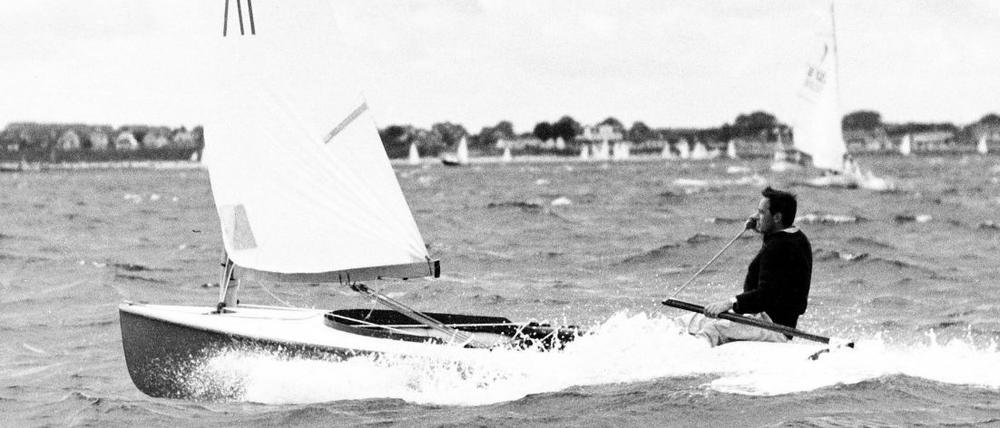
In an interview with Der Tagesspiegel, Olympic sailing champion Willy Kuhweide reflected on one of the most unusual Olympic stories in German sporting history. Kuhweide won the gold medal in the Finn class at the 1964 Olympic Games in Tokyo, representing a united German team at a time when the Berlin Wall had already divided the country.
The road to the Olympic regatta, however, was anything but straightforward. As Kuhweide explained during the conversation, the selection process between East and West German sailing associations had become entangled in political tensions. Competitors from the East German team sometimes sailed in coordinated groups against him during qualification races — a tactic he later described as an early form of what is now known as team sailing.
“I packed up my boat and prepared it for winter”
Frustrated by what he considered unfair conditions, Kuhweide temporarily withdrew from the selection process altogether. “For me the season was finished,” he recalled. “I packed up my boat and prepared it for winter.”
The situation remained unresolved until shortly before the Olympic Games themselves. Only after the team had already traveled to Tokyo did officials decide that Kuhweide and his East German rival Bernd Dehmel should settle the question in a direct race. Yet even that confrontation never took place. Dehmel was reportedly not allowed to compete by his own federation, and shortly before the opening ceremony the International Olympic Committee confirmed Kuhweide as the German representative.
The sudden decision left him little time to prepare mentally. Looking back, Kuhweide admitted that the moment was overwhelming. “I felt completely overwhelmed,” he said, laughing about the memory decades later.
Despite the chaotic circumstances, he quickly found his rhythm once the regatta began. After finishing second in the opening race and winning the next one, Kuhweide took the lead and held it throughout the remainder of the competition, eventually securing the gold medal.
During the interview, Kuhweide also reflected on how politics influenced sport during the Cold War. At the time, athletes themselves had little control over the broader political conflicts surrounding them. Today, he says, those tensions belong to history. He and his former rival Bernd Dehmel eventually became friends.
Growing up around sailing on Berlin’s Wannsee, Kuhweide explained that the sport had been part of his life from an early age. “I never really learned sailing,” he said. “I simply grew up with it.”
Decades later, the Olympic victory remains one of the most remarkable moments in German sailing history — not only because of the medal itself, but also because of the extraordinary political context in which it was won.